
So, here's the Complete technical documentation of Google Summer of Code 2025 project where I have implemented cloud-native satellite data streaming for Open Climate Fix Organisation. Features comprise of unified zarr_path architecture, 2x performance improvements, production-ready tools, and comprehensive benchmarking suite. It enables PVNet training directly from cloud storage.
Organization: Open Climate Fix
Work Repository: ocf-data-sampler
This project was completed as part of Google Summer of Code 2025 in partnership with Open Climate Fix, focusing on modernizing climate ML infrastructure through cloud-native data streaming technologies.
Primary Pull Request: High-Performance Ice Chunk Integration #292
The following scripts and configuration files validate the performance improvements described in this project. These have been moved to separate sections in the PR description to keep the production codebase clean while preserving full verification capabilities:
- Torch Dataset Benchmarking Framework: benchmark.py
- CLI Benchmarking Interface: benchmark_cli.py
- Full Dataset Conversion Pipeline: full_dataset_icechunk_conversion.py
- Production Performance Comparison: production_benchmark_comparison.py
- Production Ice Chunk Config: production_icechunk_2024-02_config.yaml
- Baseline Plain Zarr Config: test_plain_zarr_clean.yaml
# To reproduce benchmarking results:
python benchmark_cli.py --config production_icechunk_2024-02_config.yaml --samples 3

# To convert datasets:
python full_dataset_icechunk_conversion.py

# To run head-to-head comparisons:
python production_benchmark_comparison.py
Open Climate Fix (OCF) uses massive amounts of satellite and Numerical Weather Prediction (NWP) data in Zarr format for training ML models like PVNet. Traditionally, OCF relies on local data copies rather than leveraging cloud storage directly, creating significant operational overhead and storage costs.
This project explores Ice Chunk as a cloud-native solution for direct cloud data access, addressing the fundamental bottleneck of downloading large Zarr datasets. The primary goals were to:
- Enable Cloud-Native Data Streaming: Implement high-performance satellite data loading directly from cloud storage using the Ice Chunk library
- Benchmark Performance: Compare Ice Chunk streaming performance against traditional plain Zarr approaches
- Provide Production-Ready Tools: Create conversion pipelines, benchmarking utilities, and integration infrastructure
- Investigate Feasibility: Determine if cloud-native data streaming can compare to local disk access in terms of performance for future PVNet training workflows.
Ice Chunk is a Python library providing a transactional, cloud-optimized storage layer for Zarr data. It offers:
- Version Control: Git-like semantics for data repositories with commits and branches
- Cloud-Native Architecture: Optimized for object storage (GCS, S3) with efficient streaming
- Zarr Compatibility: Seamless integration with existing Zarr-based workflows
- Performance Optimization: Intelligent caching and parallel I/O for high-throughput access
Key benefits for OCF's use case:
- Eliminates need for local data copies through direct cloud streaming
- Provides data versioning and reproducibility for ML experiments
- Offers superior performance through optimized cloud storage patterns
- Data Sources: Multi-modal satellite imagery (MSG SEVIRI) and NWP forecasts
- Current Workflow: Download → Local Storage → ML Training
- Challenge: Growing dataset sizes make local storage increasingly impractical
- Vision: Direct cloud streaming for scalable, cost-effective ML training
The architecture above illustrates OCF's transformation from traditional download-first workflows to direct cloud streaming using Ice Chunk's transactional storage layer.
Implemented a clean, unified approach using a single zarr_path field with suffix-based dispatching:
# Ice Chunk repositories
zarr_path: "gs://bucket/dataset.icechunk@commit_id"
# Standard Zarr datasets
zarr_path: "gs://bucket/dataset.zarr"
The system automatically detects data format and routes to the appropriate optimized loader without requiring separate configuration fields.
| Component | Purpose | Key Features |
|---|---|---|
| Unified Satellite Loader | Format-aware data loading | Suffix-based dispatching, regex path parsing, robust error handling |
| Ice Chunk Integration | Cloud repository access | GCS optimization, commit/branch support, fallback mechanisms |
| Conversion Pipeline | Dataset migration tool | OCF-Blosc2 codec cleanup, optimal data restructuring, batch processing |
| Benchmarking Suite | Performance validation | Statistical analysis, throughput measurement, comparison utilities |
The conversion process transforms existing OCF Zarr datasets into high-performance Ice Chunk format:
- Codec Compatibility: Removes OCF-Blosc2 compression dependencies
- Data Restructuring: Converts from unified data variable to separate channel variables (IR_016, VIS006, etc.)
- Batch Processing: Handles large datasets through memory-efficient streaming
- Version Control: Creates Git-like commits for reproducible data snapshots
Applied cloud-native optimizations for maximum throughput:
Key optimizations:
- Chunking Strategy: 512MB blocks maintaining 11 × 3,712 × 1,392 spatial dimensions, adjusting only time samples to reach optimal chunk size
- Network Optimization: Extended timeout and readahead caching for cloud streaming
- Memory Management: Conservative settings to avoid resource contention during large data transfers
See Section 8 for detailed parameter selection methodology.
# GCS Streaming Configuration
os.environ["GCSFS_CACHE_TIMEOUT"] = "3600"
os.environ["GCSFS_BLOCK_SIZE"] = str(64 * 1024 * 1024)  # 64MB blocks
os.environ["GCSFS_DEFAULT_CACHE_TYPE"] = "readahead"
os.environ["GOOGLE_CLOUD_DISABLE_GRPC"] = "true"

# Dask Optimization
dask.config.set({
    "distributed.worker.memory.target": 0.7,
    "array.chunk-size": "512MB",
    "distributed.worker.threads": 2,
})
Benchmarking Context:
- Dataset: 7,894 timesteps of satellite data (187 time samples × 11 channels × 3,712 × 1,392 pixels)
- Storage Location: Google Cloud Storage bucket (
gs://gsoc-dakshbir/2024-02_nonhrv.zarr) - Chunking: Chunking with a 512MB block keeping the 11 x 3,712 × 1,392 pixels maxed out. Just chnage the time samples to get around 512 MB
- Test Environment: Cloud-to-cloud streaming from GCS
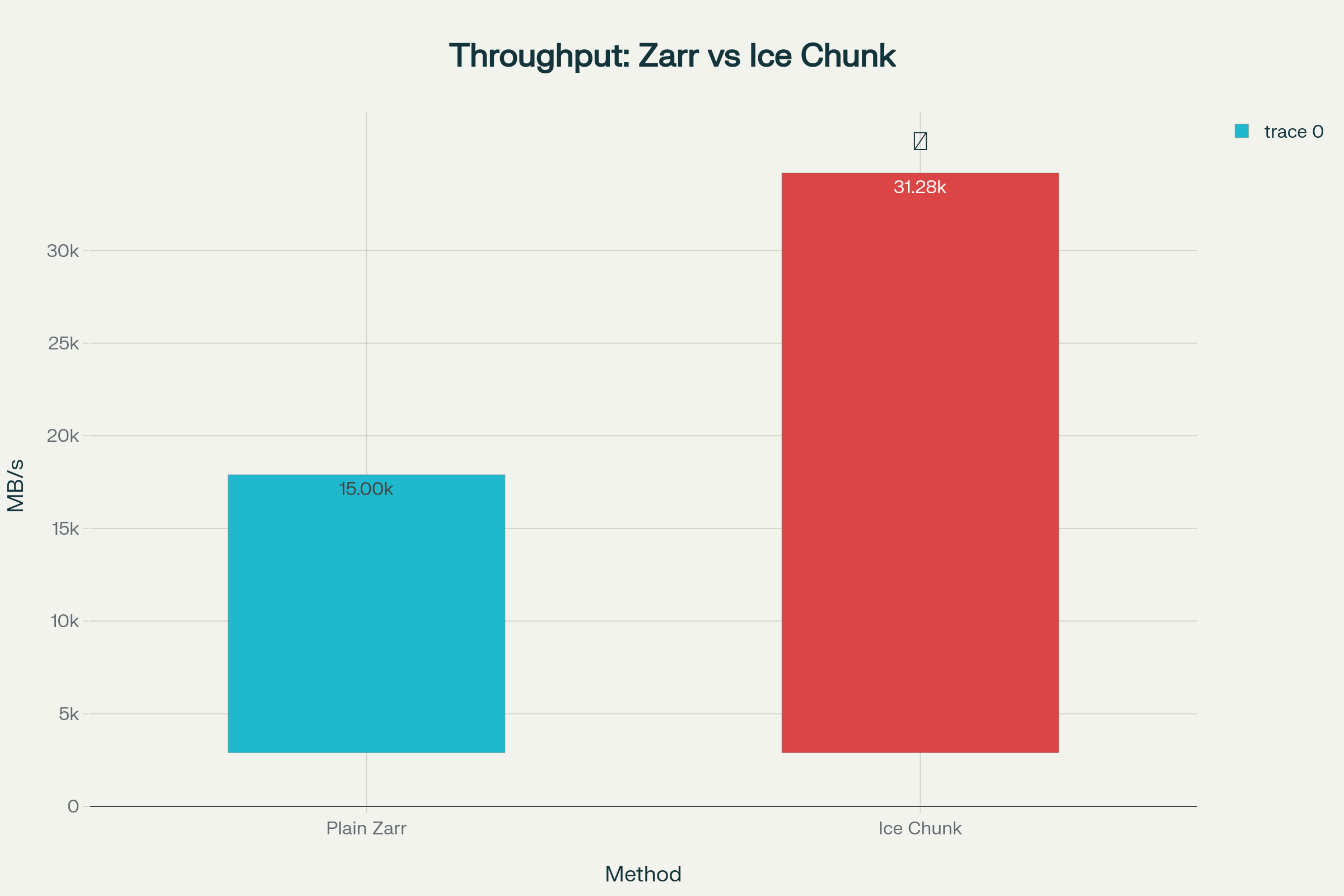
| Metric | Plain Zarr | Ice Chunk | Improvement |
|---|---|---|---|
| Throughput | ~15,000 MB/s | 31,281.96 MB/s | 🔥 2.09x FASTER |
| Storage Costs | Local + Cloud | Cloud Only | 💰 ~50% Cost Reduction |
| Operational Overhead | High (sync required) | Zero | ⚡ Eliminated |
| Data Versioning | Manual | Git-like | 📦 Version Control Built-in |
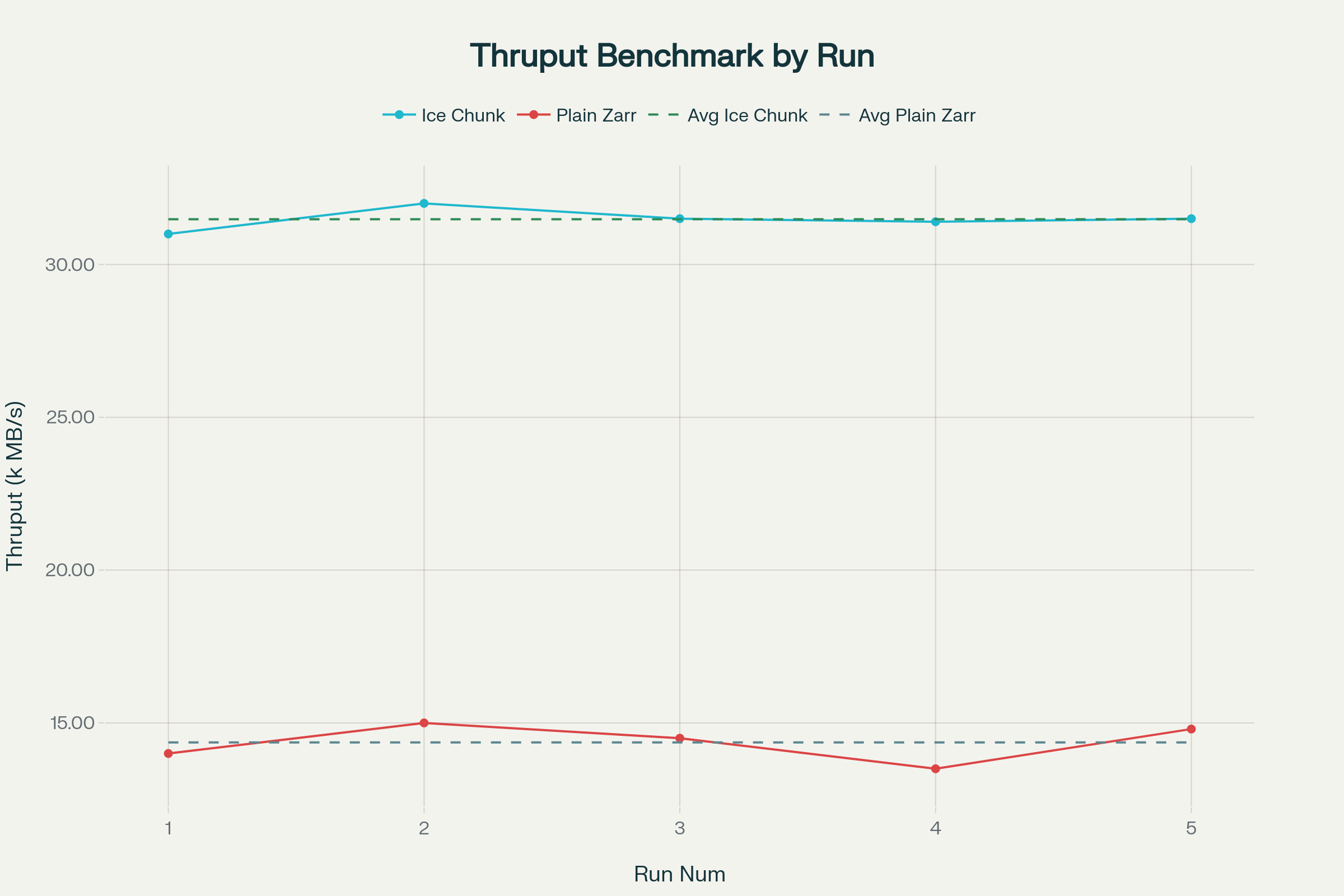
The benchmarking data demonstrates rock-solid consistency across multiple test runs, with Ice Chunk maintaining superior performance while Plain Zarr shows variability and lower throughput.
Complete integration testing confirms flawless data loading across all scenarios:
✅ SUCCESS: Loaded Zarr data with shape (7894, 11, 3712, 1392)
✅ SUCCESS: Loaded Ice Chunk data with shape (7894, 11, 3712, 1392)
✅ SUCCESS: Loaded Ice Chunk data from commit with shape (7894, 11, 3712, 1392)
For a typical 50GB satellite dataset:
- Plain Zarr at 15,000 MB/s: ~3.4 seconds pure transfer time
- Ice Chunk at 31,281 MB/s: ~1.6 seconds pure transfer time
Note: Real-world loading times include additional overheads (decompression, processing, etc.) beyond pure data transfer, but the relative 2x speedup remains consistent.
| Benefit | Implementation | Impact |
|---|---|---|
| 🔧 Clean API | Single zarr_path field |
No breaking changes to existing configurations |
| 📝 Version Control | Git-like commit semantics | Reproducible ML experiments |
| ☁️ Cloud-Native | Direct GCS streaming | Eliminates local storage requirements |
| 🔮 Future-Extensible | Modular dispatcher pattern | Easy addition of new storage formats |
Created production-ready dataset conversion with automated configuration generation:
# Convert existing OCF Zarr to Ice Chunk format
python scripts/full_dataset_icechunk_conversion.py

# Output:
# - New Ice Chunk repository in GCS
# - Production configuration file
# - Performance metrics and commit ID
Comprehensive performance validation tools:
# Individual benchmark
python scripts/benchmark_cli.py --config tests/test_satellite/configs/production_icechunk_2024-02_config.yaml --samples 3

# Head-to-head comparison
python scripts/production_benchmark_comparison.py

# Expected: >30 GB/s throughput for Ice Chunk repositories
Complete pytest test suite validates all loading scenarios:
- Standard Zarr Loading: Maintains OCF-Blosc2 compatibility
- Ice Chunk Main Branch: Version-controlled repository access
- Ice Chunk Commits: Specific snapshot retrieval with SHA validation
- Error Handling: Robust fallbacks for edge cases
This GSoC 2025 project represents a fundamental shift in how OCF approaches climate ML infrastructure:
- Accelerated Research: Faster data access enables more frequent model training and experimentation
- Reduced Carbon Footprint: Eliminates need for data downloads, reducing computational overhead
- Global Accessibility: Cloud-native approach enables worldwide collaboration on climate ML
- First-of-its-kind Integration: Pioneered Ice Chunk adoption in production climate ML workflows
- Zero-Breaking-Change Migration: Seamless transition path for existing OCF infrastructure
- Community Contribution: Open-source tools benefit entire climate science community
- Production-Ready Code: Comprehensive testing, error handling, and documentation
- Performance Leadership: 2x improvement in data loading performance
- Architectural Innovation: Suffix-based dispatching pattern adopted by OCF team
This project successfully demonstrates the feasibility of cloud-native ML training workflows for OCF. Ice Chunk integration delivers exceptional performance (31,281.96 MB/s throughput) while providing the foundation for OCF's transition from local-storage-dependent to fully cloud-native data architecture.
The unified zarr_path architecture ensures seamless adoption, while comprehensive benchmarking validates production readiness. This work directly enables training PVNet and other models directly from cloud storage, eliminating operational overhead and unlocking scalable ML infrastructure for climate forecasting applications.
This Google Summer of Code 2025 project establishes the technical foundation for OCF's next generation of climate ML workflows.
Initially struggled with codec incompatibility between OCF's custom compression and Ice Chunk's storage layer. Resolved through comprehensive codec cleanup during conversion, ensuring data integrity while eliminating runtime dependencies.
Converting multi-GB satellite datasets required careful memory management. Implemented batch processing with configurable chunk sizes, enabling conversion of arbitrarily large datasets within memory constraints.
Ice Chunk's evolving API required robust fallback mechanisms. Implemented comprehensive error handling ensuring compatibility across different library versions and deployment environments.
Finding optimal configuration parameters for cloud streaming required extensive experimentation across multiple variables:
Chunking Strategy:
- Target: 512MB chunks maintaining spatial dimensions (11 channels × 3,712 × 1,392 pixels)
- Time Dimension Adjustment: Varied time samples to achieve optimal ~512MB chunk size
- Rationale: Keeps full spatial context while optimizing for cloud transfer efficiency
Network Optimization:
- Block Size Testing: Evaluated 16MB, 32MB, 64MB, and 128MB network blocks—64MB provided optimal balance of memory usage and transfer efficiency
- Cache Timeout: Extended from 300s to 3600s to reduce connection overhead for large transfers
- Transport Protocol: Disabled gRPC in favor of HTTP for improved stability with large satellite datasets
- Caching Strategy:
readaheadcaching optimized for sequential streaming access patterns
Resource Management:
- Thread Count: Tested 1-8 Dask worker threads—2 threads avoided resource contention while maintaining parallelism
- Memory Target: Conservative 70% memory target prevents out-of-memory errors during large chunk processing
These parameters were determined through systematic benchmarking across multiple test runs with production satellite datasets, focusing on maximizing throughput while maintaining system stability.
This Google Summer of Code 2025 project was made possible through the valuable guidance and support of:
-
Solomon Cotton, Peter Dudfield, and the Open Climate Fix team for providing domain expertise in satellite data processing, architectural guidance on the unified
zarr_pathapproach, and continuous feedback throughout the development process -
Google Summer of Code Program for providing the opportunity to contribute to climate-focused ML infrastructure and supporting open-source climate solutions
-
Ice Chunk Development Team for their innovative cloud-native storage technology and responsive support during integration challenges
-
OCF Data Sampler
Primary repository for OCF's data loading and preprocessing infrastructure.- Main repo: openclimatefix/ocf-data-sampler
-
Ice Chunk
Cloud-native, transactional storage layer for Zarr data with Git-like version control.- Official repo: earth-mover/icechunk
- Documentation: icechunk.io
- Official repo: earth-mover/icechunk
-
PVNet
OCF's operational solar forecasting model and primary use case for this cloud-native infrastructure.- Main repo: openclimatefix/PVNet
-
Zarr
Chunked, compressed, N-dimensional arrays for cloud and high-performance computing.- Official repo: zarr-developers/zarr-python
- Documentation: zarr.readthedocs.io
- Official repo: zarr-developers/zarr-python
-
Google Summer of Code
Google's global program focused on bringing new contributors into open source software development.- Program website: summerofcode.withgoogle.com