| Model | Release Date | Context Window | Input Price | Output Price | Notes |
|---|---|---|---|---|---|
| deepseek/deepseek-chat-v3-0324 | 2025-03-24 | 163,840 | $0.20 / M tokens | $0.77 / M tokens | — |
| google/gemini-2.5-flash | 2025-06-17 | 1,048,576 | $0.30 / M tokens | $2.50 / M tokens | $1 / M audio tokens |
| google/gemini-3-flash-preview | 2025-12-17 | 1,048,576 | $0.50 / M tokens | $3.00 / M tokens | $1 / M audio tokens |
| minimax/minimax-m2.5 | 2026-02-12 | 196,608 | $0.295 / M tokens | $1.20 / M tokens | — |
| openai/gpt-5-mini | 2025-08-07 | 400,000 | $0.25 / M tokens | $2.00 / M tokens | $10 / K web search |
| openai/gpt-5-nano | 2025-08-07 | 400,000 | $0.05/M tokens | $0.40/M tokens | $10/K web search |
| x-ai/grok-4.1-fast | 2025-11-19 | 2,000,000 | Starting at $0.20 / M tokens | Starting at $0.50 / M tokens | $5 / K web search |

Last active
March 6, 2026 16:01
-
-
Save philipmat/bb8d3b7a6269191e693b8930044094d9 to your computer and use it in GitHub Desktop.
Experiment with model summaries
This file contains hidden or bidirectional Unicode text that may be interpreted or compiled differently than what appears below. To review, open the file in an editor that reveals hidden Unicode characters.
Learn more about bidirectional Unicode characters
| /* | |
| deepseek/deepseek-chat-v3-0324 | |
| Released Mar 24, 2025 | |
| 163,840 context | |
| $0.20/M input tokens, $0.77/M output tokens | |
| */ | |
| { | |
| "title": "Automating GitHub Profile READMEs with Actions and GraphQL", | |
| "slug": "automating-github-profile-readmes-with-actions-and-graphql", | |
| "summary": "GitHub introduced profile READMEs that display at the top of user profiles when a repository matching the username contains a README.md. Simon Willison created a self-updating profile by using a GitHub Action that runs a Python script to fetch his latest project releases (via GitHub's GraphQL API), blog posts (via Atom feed), and TIL entries (via Datasette API), then dynamically updates the README.md. The solution demonstrates efficient GraphQL pagination for querying multiple repositories and uses commented markers in the README to identify update sections.", | |
| "tags": ["github", "github-actions", "graphql", "automation", "python"], | |
| "snippet": "How to create a self-updating GitHub profile README using Actions, GraphQL, and Python." | |
| } |
This file contains hidden or bidirectional Unicode text that may be interpreted or compiled differently than what appears below. To review, open the file in an editor that reveals hidden Unicode characters.
Learn more about bidirectional Unicode characters
| /* | |
| google/gemini-2.5-flash | |
| Released Jun 17, 2025 | |
| 1,048,576 context | |
| $0.30/M input tokens; $2.50/M output tokens; $1/M audio tokens | |
| */ | |
| // NOTE: indented | |
| { | |
| "title": "Building a Self-Updating Profile README for GitHub", | |
| "slug": "building-self-updating-profile-readme-github", | |
| "summary": "This article demonstrates how to create a dynamic GitHub profile README that automatically updates with current information. The process involves setting up a GitHub Action to run periodically or on demand, executing a Python script. This script fetches data such as latest project releases from the GitHub GraphQL API, recent blog entries from an Atom feed, and latest TILs from a Datasette API.\n\nThe collected data is then formatted into markdown and injected into specific comment blocks within the `README.md` file. The author highlights the advantages of using GitHub's GraphQL API for efficiently querying information across numerous repositories, particularly when dealing with pagination for large datasets, contrasting its efficiency with the limitations of the traditional REST API.", | |
| "tags": [ | |
| "github", | |
| "projects", | |
| "graphql", | |
| "github-actions", | |
| "python" | |
| ], | |
| "snippet": "Simon Willison details how to create a dynamic GitHub profile README that automatically updates with latest project releases, blog posts, and TILs using GitHub Actions, Python, and the GitHub GraphQL API." | |
| } |
This file contains hidden or bidirectional Unicode text that may be interpreted or compiled differently than what appears below. To review, open the file in an editor that reveals hidden Unicode characters.
Learn more about bidirectional Unicode characters
| /* | |
| google/gemini-3-flash-preview | |
| Released Dec 17, 2025 | |
| 1,048,576 context | |
| $0.50/M input tokens; $3/M output tokens; $1/M audio tokens | |
| */ | |
| // NOTE: indented | |
| { | |
| "title": "Building a Self-Updating GitHub Profile README", | |
| "slug": "self-updating-github-profile-readme", | |
| "summary": "Simon Willison demonstrates how to leverage GitHub's profile README feature to create a dynamic, self-updating landing page. By creating a repository with the same name as a username, GitHub renders the `README.md` at the top of the personal profile page. Willison automates this file using a GitHub Action triggered by the `workflow_dispatch` event, a schedule, or pushes to the repository. \n\nThe automation relies on a Python script, `build_readme.py`, which fetches data from multiple sources: the GitHub GraphQL API for project releases, an Atom feed for blog posts, and a Datasette API for \"Today I Learned\" entries. The script identifies specific placeholders in the Markdown file, such as `<!-- recent_releases starts -->`, and injects the latest links automatically. This approach highlights the efficiency of the GitHub GraphQL API, which allows fetching data for hundreds of repositories in a single request compared to multiple REST API calls.", | |
| "tags": [ | |
| "github-actions", | |
| "python", | |
| "graphql", | |
| "automation", | |
| "github" | |
| ], | |
| "snippet": "Learn how to use GitHub Actions and Python to automate a personal profile README with dynamic content from APIs and RSS feeds." | |
| } |
This file contains hidden or bidirectional Unicode text that may be interpreted or compiled differently than what appears below. To review, open the file in an editor that reveals hidden Unicode characters.
Learn more about bidirectional Unicode characters
| /* | |
| openai/gpt-5-mini | |
| Released Aug 7, 2025 | |
| 400,000 context | |
| $0.25/M input tokens; $2/M output tokens; $10/K web search | |
| */ | |
| // NOTE: indented | |
| { | |
| "title": "Self-updating GitHub profile README with Actions and GraphQL", | |
| "slug": "self-updating-github-profile-readme", | |
| "summary": "GitHub added profile READMEs and Simon Willison built a GitHub Action to keep his profile README automatically up-to-date. A Python script generates a three-column README by pulling together his latest repository releases, recent blog posts, and latest TILs and injects them into commented blocks in the README.\n\nTechnically, the script uses the GitHub GraphQL API to fetch the most recent release for each repository (avoiding hundreds of REST calls), handles GraphQL pagination, uses feedparser to read his blog's Atom feed, and queries a Datasette API for recent TILs. The workflow runs on push, on a schedule, and via manual `workflow_dispatch`, and the whole build script is under 150 lines of Python; Willison notes potential future additions like tweets or PyPI stats.", | |
| "tags": [ | |
| "github", | |
| "github-actions", | |
| "graphql", | |
| "python", | |
| "automation" | |
| ], | |
| "snippet": "Automated a GitHub profile README using a GitHub Action and a short Python script that pulls releases via GraphQL, blog posts via Atom, and TILs via Datasette." | |
| } |
This file contains hidden or bidirectional Unicode text that may be interpreted or compiled differently than what appears below. To review, open the file in an editor that reveals hidden Unicode characters.
Learn more about bidirectional Unicode characters
| /* | |
| openai/gpt-5-nano | |
| Released Aug 7, 2025 | |
| 400,000 context | |
| $0.05/M input tokens; $0.40/M output tokens; $10/K web search | |
| */ | |
| { | |
| "title": "Self-updating profile README for GitHub", | |
| "slug": "self-updating-profile-readme-github", | |
| "summary": "Self-updating profile READMEs are a GitHub feature. This post describes building a GitHub Action that keeps the profile README current by collecting data from multiple sources: the latest releases across 300+ repositories via the GraphQL API, recent blog entries via an Atom feed, and the latest TILs via a Datasette API. The action compiles these into a markdown list of links and updates the README by replacing comment blocks that mark the data sections.\n\nThe script is small (under 150 lines) and demonstrates a GraphQL query to fetch the most recent release for each public repository, including pagination via endCursor, with triggers on push, schedule, and a manual workflow_dispatch. It also notes potential future additions like tweets or extra links.", | |
| "tags": ["github", "automation", "graphql", "python", "datasette"], | |
| "snippet": "Describes building a GitHub Action that auto-updates a profile README by aggregating latest releases, blog posts, and TILs using GraphQL, Atom feeds, and a Datasette API." | |
| } |
This file contains hidden or bidirectional Unicode text that may be interpreted or compiled differently than what appears below. To review, open the file in an editor that reveals hidden Unicode characters.
Learn more about bidirectional Unicode characters
| /* | |
| x-ai/grok-4.1-fast | |
| Released Nov 19, 2025 | |
| 2,000,000 context | |
| Starting at $0.20/M input tokens; Starting at $0.50/M output tokens; $5/K web search | |
| */ | |
| { | |
| "title": "Building a Self-Updating GitHub Profile README", | |
| "slug": "building-self-updating-github-profile-readme", | |
| "summary": "Simon Willison created a self-updating GitHub profile README by naming a repository after his username and adding a README.md file, which GitHub renders at the top of his profile page. He implemented a GitHub Action that runs a Python script to fetch and update content: latest releases from over 300 repositories via the GitHub GraphQL API (efficiently querying the most recent release per repo with pagination), recent blog posts from his Atom feed using feedparser, and newest TILs from his Datasette API.\n\nThe script replaces commented blocks in the README with markdown lists of these items and is under 150 lines. The workflow triggers on pushes, hourly schedules, and manual dispatch. GraphQL is highlighted for reducing API calls compared to REST, with an example query provided.", | |
| "tags": [ | |
| "github", | |
| "github-actions", | |
| "graphql", | |
| "python", | |
| "automation" | |
| ], | |
| "snippet": "Simon Willison built a dynamic GitHub profile README that auto-updates with latest repo releases via GraphQL, blog posts, and TILs using a concise Python script in GitHub Actions." | |
| } |
This file contains hidden or bidirectional Unicode text that may be interpreted or compiled differently than what appears below. To review, open the file in an editor that reveals hidden Unicode characters.
Learn more about bidirectional Unicode characters
| You are a helpful assistant that creates blog post metadata and summaries. When summarizing articles, produce a standalone summary of the article's key points. You always respond with valid JSON and nothing else. | |
| I want to create a short "Today I Learned" blog post based on the following article. | |
| Article content: | |
| --- | |
| # [Simon Willison’s Weblog](/) | |
| ## Building a self-updating profile README for GitHub | |
| 10th July 2020 | |
| GitHub quietly released a new feature at some point in the past few days: profile READMEs. Create a repository with the same name as your GitHub account (in my case that’s [github.com/simonw/simonw](https://github.com/simonw/simonw)), add a `README.md` to it and GitHub will render the contents at the top of your personal profile page—for me that’s [github.com/simonw](https://github.com/simonw) | |
| I couldn’t resist re-using the trick [from this blog post](https://simonwillison.net/2020/Apr/20/self-rewriting-readme/) and implementing a GitHub Action to automatically keep my profile README up-to-date. | |
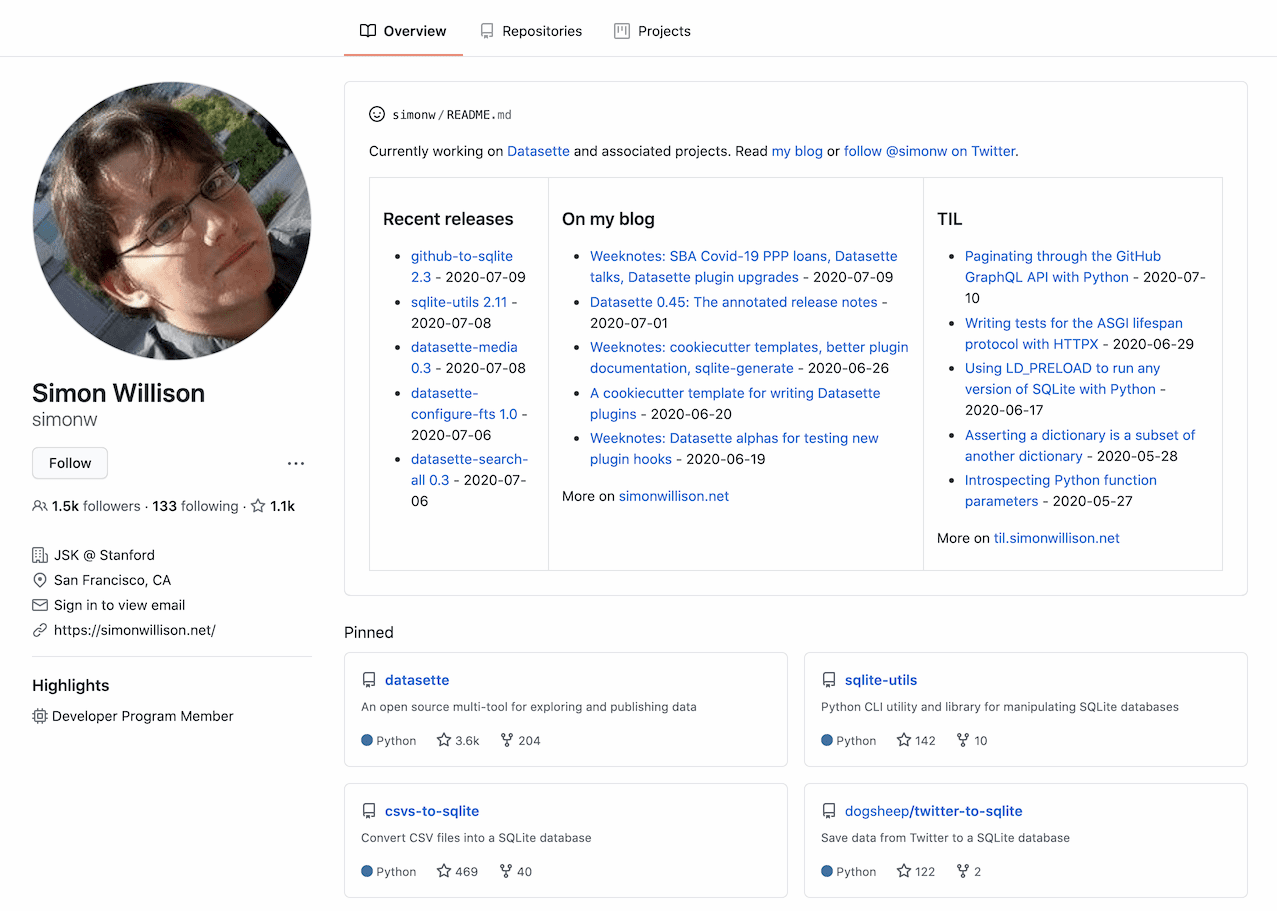
| Visit [github.com/simonw](https://github.com/simonw) and you’ll see a three-column README showing my latest GitHub project releases, my latest blog entries and my latest [TILs](https://til.simonwillison.net/). | |
|  | |
| I’m doing this with a GitHub Action in [build.yml](https://github.com/simonw/simonw/blob/master/.github/workflows/build.yml). It’s configured to run on every push to the repo, on a schedule at 32 minutes past the hour and on the new `workflow_dispatch` event which means I get a [manual button I can click](https://github.blog/changelog/2020-07-06-github-actions-manual-triggers-with-workflow_dispatch/) to trigger it on demand. | |
| The Action runs a Python script called [build\_readme.py](https://github.com/simonw/simonw/blob/master/build_readme.py) which does the following: | |
| * Hits the GitHub GraphQL API to retrieve the latest release for every one of my 300+ repositories | |
| * Hits my blog’s [full entries Atom feed](https://simonwillison.net/atom/entries/) to retrieve the most recent posts (using the [feedparser](https://pypi.org/project/feedparser/) Python library) | |
| * Hits my TILs website’s Datasette API running [this SQL query](https://til.simonwillison.net/til?sql=select+title%2C+url%2C+created_utc+from+til+order+by+created_utc+desc+limit+5) to return the latest TIL links | |
| It then turns the results from those various sources into a markdown list of links and replaces commented blocks in the README that look like this: | |
| ``` | |
| <!-- recent_releases starts --> | |
| ... | |
| <!-- recent_releases ends --> | |
| ``` | |
| The whole script is [less than 150 lines of Python](https://github.com/simonw/simonw/blob/master/build_readme.py). | |
| #### GitHub GraphQL | |
| I have a bunch of experience working with GitHub’s regular REST APIs, but for this project I decided to go with their newer [GraphQL API](https://developer.github.com/v4/). | |
| I wanted to show the most recent “releases” for all of my projects. I have over 300 GitHub repositories now, and only a portion of them use the releases feature. | |
| Using REST, I would have to make over 300 API calls to figure out which ones have releases. | |
| With GraphQL, I can do this instead: | |
| ``` | |
| query { | |
| viewer { | |
| repositories(first: 100, privacy: PUBLIC) { | |
| pageInfo { | |
| hasNextPage | |
| endCursor | |
| } | |
| nodes { | |
| name | |
| releases(last:1) { | |
| totalCount | |
| nodes { | |
| name | |
| publishedAt | |
| url | |
| } | |
| } | |
| } | |
| } | |
| } | |
| } | |
| ``` | |
| This query returns the most recent release (`last:1`) for each of the first 100 of my public repositories. | |
| You can paste it into the [GitHub GraphQL explorer](https://developer.github.com/v4/explorer/) to run it against your own profile. | |
| There’s just one catch: pagination. I have more than 100 repos but their GraphQL can only return 100 nodes at a time. | |
| To paginate, you need to request the `endCursor` and then pass that as the `after:` parameter for the next request. I wrote up how to do this in [this TIL](https://github.com/simonw/til/blob/master/github/graphql-pagination-python.md). | |
| #### Next steps | |
| I’m pretty happy with this as a first attempt at automating my profile. There’s something extremely satsifying about having a GitHub profile that self-updates itself using GitHub Actions—it feels appropriate. | |
| There’s so much more stuff I could add to this: my tweets, my sidebar blog links, maybe even download statistics from PyPI. I’ll see what takes my fancy in the future. | |
| I’m not sure if there’s a size limit on the README that is displayed on the profile page, so deciding how much information is appropriate is appears to be mainly a case of personal taste. | |
| Building these automated profile pages is pretty easy, so I’m looking forward to seeing what kind of things other nerds come up with! | |
| Posted [10th July 2020](/2020/Jul/10/) at 4:41 am · Follow me on [Mastodon](https://fedi.simonwillison.net/%40simon), [Bluesky](https://bsky.app/profile/simonwillison.net), [Twitter](https://twitter.com/simonw) or [subscribe to my newsletter](https://simonwillison.net/about/#subscribe) | |
| ## More recent articles | |
| * [Can coding agents relicense open source through a “clean room” implementation of code?](/2026/Mar/5/chardet/) - 5th March 2026 | |
| * [Something is afoot in the land of Qwen](/2026/Mar/4/qwen/) - 4th March 2026 | |
| * [I vibe coded my dream macOS presentation app](/2026/Feb/25/present/) - 25th February 2026 | |
| This is **Building a self-updating profile README for GitHub** by Simon Willison, posted on [10th July 2020](/2020/Jul/10/). | |
| [github | |
| 180](/tags/github/) | |
| [projects | |
| 522](/tags/projects/) | |
| [graphql | |
| 21](/tags/graphql/) | |
| [github-actions | |
| 64](/tags/github-actions/) | |
| **Next:** [Weeknotes: datasette-auth-passwords, a Datasette logo and a whole lot more](/2020/Jul/17/weeknotes-datasette-logo/) | |
| **Previous:** [Weeknotes: SBA Covid-19 PPP loans, Datasette talks, Datasette plugin upgrades](/2020/Jul/9/sba-covid-19-ppp-loans/) | |
| --- | |
| Please respond with a JSON object containing: | |
| - "title": A concise, descriptive title for the blog post (do NOT prefix with "TIL:") | |
| - "slug": A URL-friendly slug (lowercase, hyphens only, no special characters, max 60 chars) | |
| - "summary": A 1-2 paragraph summary of the article's key points. | |
| Do NOT weave in my comments -- summarize the article itself only. | |
| My comments will appear separately in the post. | |
| - "tags": An array of 1-5 lowercase tags categorizing the content | |
| (e.g., ["python", "web-development", "security"]) | |
| - "snippet": A single sentence (max 200 chars) summarizing the post for an archive listing | |
| Respond with ONLY the JSON object, no markdown fences or other text. |
This file contains hidden or bidirectional Unicode text that may be interpreted or compiled differently than what appears below. To review, open the file in an editor that reveals hidden Unicode characters.
Learn more about bidirectional Unicode characters
| /* | |
| minimax/minimax-m2.5 | |
| Released Feb 12, 2026 | |
| 196,608 context | |
| $0.295/M input tokens, $1.20/M output tokens | |
| */ | |
| { | |
| "title": "Building a Self-Updating GitHub Profile README", | |
| "slug": "self-updating-github-profile-readme", | |
| "summary": "Simon Willison demonstrates how to create a self-updating GitHub profile README using a GitHub Action. The setup involves creating a repository matching your username and adding a README.md file. The GitHub Action runs on a schedule and fetches data from multiple sources—latest repository releases via the GitHub GraphQL API, recent blog posts from an Atom feed, and TIL entries from a Datasette API—then automatically replaces commented blocks in the README with fresh content. The entire solution is implemented in under 150 lines of Python.", | |
| "tags": [ | |
| "github", | |
| "github-actions", | |
| "python", | |
| "graphql", | |
| "automation" | |
| ], | |
| "snippet": "A tutorial on creating a self-updating GitHub profile README using GitHub Actions that automatically pulls releases, blog posts, and TILs." | |
| } |
This file contains hidden or bidirectional Unicode text that may be interpreted or compiled differently than what appears below. To review, open the file in an editor that reveals hidden Unicode characters.
Learn more about bidirectional Unicode characters
| # [Simon Willison’s Weblog](/) | |
| ## Building a self-updating profile README for GitHub | |
| 10th July 2020 | |
| GitHub quietly released a new feature at some point in the past few days: profile READMEs. Create a repository with the same name as your GitHub account (in my case that’s [github.com/simonw/simonw](https://github.com/simonw/simonw)), add a `README.md` to it and GitHub will render the contents at the top of your personal profile page—for me that’s [github.com/simonw](https://github.com/simonw) | |
| I couldn’t resist re-using the trick [from this blog post](https://simonwillison.net/2020/Apr/20/self-rewriting-readme/) and implementing a GitHub Action to automatically keep my profile README up-to-date. | |
| Visit [github.com/simonw](https://github.com/simonw) and you’ll see a three-column README showing my latest GitHub project releases, my latest blog entries and my latest [TILs](https://til.simonwillison.net/). | |
|  | |
| I’m doing this with a GitHub Action in [build.yml](https://github.com/simonw/simonw/blob/master/.github/workflows/build.yml). It’s configured to run on every push to the repo, on a schedule at 32 minutes past the hour and on the new `workflow_dispatch` event which means I get a [manual button I can click](https://github.blog/changelog/2020-07-06-github-actions-manual-triggers-with-workflow_dispatch/) to trigger it on demand. | |
| The Action runs a Python script called [build\_readme.py](https://github.com/simonw/simonw/blob/master/build_readme.py) which does the following: | |
| * Hits the GitHub GraphQL API to retrieve the latest release for every one of my 300+ repositories | |
| * Hits my blog’s [full entries Atom feed](https://simonwillison.net/atom/entries/) to retrieve the most recent posts (using the [feedparser](https://pypi.org/project/feedparser/) Python library) | |
| * Hits my TILs website’s Datasette API running [this SQL query](https://til.simonwillison.net/til?sql=select+title%2C+url%2C+created_utc+from+til+order+by+created_utc+desc+limit+5) to return the latest TIL links | |
| It then turns the results from those various sources into a markdown list of links and replaces commented blocks in the README that look like this: | |
| ``` | |
| <!-- recent_releases starts --> | |
| ... | |
| <!-- recent_releases ends --> | |
| ``` | |
| The whole script is [less than 150 lines of Python](https://github.com/simonw/simonw/blob/master/build_readme.py). | |
| #### GitHub GraphQL | |
| I have a bunch of experience working with GitHub’s regular REST APIs, but for this project I decided to go with their newer [GraphQL API](https://developer.github.com/v4/). | |
| I wanted to show the most recent “releases” for all of my projects. I have over 300 GitHub repositories now, and only a portion of them use the releases feature. | |
| Using REST, I would have to make over 300 API calls to figure out which ones have releases. | |
| With GraphQL, I can do this instead: | |
| ``` | |
| query { | |
| viewer { | |
| repositories(first: 100, privacy: PUBLIC) { | |
| pageInfo { | |
| hasNextPage | |
| endCursor | |
| } | |
| nodes { | |
| name | |
| releases(last:1) { | |
| totalCount | |
| nodes { | |
| name | |
| publishedAt | |
| url | |
| } | |
| } | |
| } | |
| } | |
| } | |
| } | |
| ``` | |
| This query returns the most recent release (`last:1`) for each of the first 100 of my public repositories. | |
| You can paste it into the [GitHub GraphQL explorer](https://developer.github.com/v4/explorer/) to run it against your own profile. | |
| There’s just one catch: pagination. I have more than 100 repos but their GraphQL can only return 100 nodes at a time. | |
| To paginate, you need to request the `endCursor` and then pass that as the `after:` parameter for the next request. I wrote up how to do this in [this TIL](https://github.com/simonw/til/blob/master/github/graphql-pagination-python.md). | |
| #### Next steps | |
| I’m pretty happy with this as a first attempt at automating my profile. There’s something extremely satsifying about having a GitHub profile that self-updates itself using GitHub Actions—it feels appropriate. | |
| There’s so much more stuff I could add to this: my tweets, my sidebar blog links, maybe even download statistics from PyPI. I’ll see what takes my fancy in the future. | |
| I’m not sure if there’s a size limit on the README that is displayed on the profile page, so deciding how much information is appropriate is appears to be mainly a case of personal taste. | |
| Building these automated profile pages is pretty easy, so I’m looking forward to seeing what kind of things other nerds come up with! | |
| Posted [10th July 2020](/2020/Jul/10/) at 4:41 am · Follow me on [Mastodon](https://fedi.simonwillison.net/%40simon), [Bluesky](https://bsky.app/profile/simonwillison.net), [Twitter](https://twitter.com/simonw) or [subscribe to my newsletter](https://simonwillison.net/about/#subscribe) | |
| ## More recent articles | |
| * [Can coding agents relicense open source through a “clean room” implementation of code?](/2026/Mar/5/chardet/) - 5th March 2026 | |
| * [Something is afoot in the land of Qwen](/2026/Mar/4/qwen/) - 4th March 2026 | |
| * [I vibe coded my dream macOS presentation app](/2026/Feb/25/present/) - 25th February 2026 | |
| This is **Building a self-updating profile README for GitHub** by Simon Willison, posted on [10th July 2020](/2020/Jul/10/). | |
| [github | |
| 180](/tags/github/) | |
| [projects | |
| 522](/tags/projects/) | |
| [graphql | |
| 21](/tags/graphql/) | |
| [github-actions | |
| 64](/tags/github-actions/) | |
| **Next:** [Weeknotes: datasette-auth-passwords, a Datasette logo and a whole lot more](/2020/Jul/17/weeknotes-datasette-logo/) | |
| **Previous:** [Weeknotes: SBA Covid-19 PPP loans, Datasette talks, Datasette plugin upgrades](/2020/Jul/9/sba-covid-19-ppp-loans/) |
Sign up for free
to join this conversation on GitHub.
Already have an account?
Sign in to comment