See the new site: https://postgresisenough.dev
Locate the section for your github remote in the .git/config file. It looks like this:
[remote "origin"]
fetch = +refs/heads/*:refs/remotes/origin/*
url = git@github.com:joyent/node.git
Now add the line fetch = +refs/pull/*/head:refs/remotes/origin/pr/* to this section. Obviously, change the github url to match your project's URL. It ends up looking like this:
| # If your workers are inactive for a long period of time, they'll lose | |
| # their MySQL connection. | |
| # | |
| # This hack ensures we re-connect whenever a connection is | |
| # lost. Because, really. why not? | |
| # | |
| # Stick this in RAILS_ROOT/config/initializers/connection_fix.rb (or somewhere similar) | |
| # | |
| # From: | |
| # http://coderrr.wordpress.com/2009/01/08/activerecord-threading-issues-and-resolutions/ |
| #!/usr/bin/env ruby -w | |
| # brew-services(1) - Easily start and stop formulas via launchctl | |
| # =============================================================== | |
| # | |
| # ## SYNOPSIS | |
| # | |
| # [<sudo>] `brew services` `list`<br> | |
| # [<sudo>] `brew services` `restart` <formula><br> | |
| # [<sudo>] `brew services` `start` <formula> [<plist>]<br> |
Eventually platforms outgrow the single-source-tree model and become distributed systems. A common pattern in these distributed systems is distributed composition via event buffering. Here we motivate and describe this event buffering pattern.
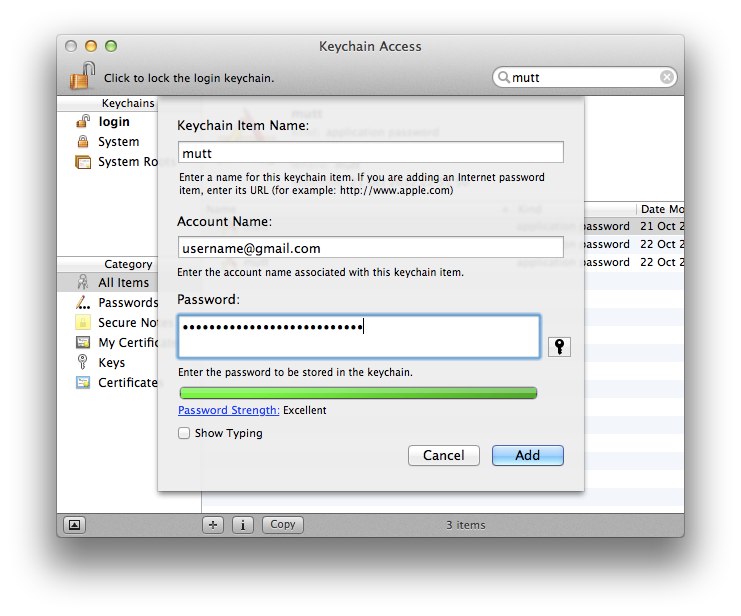
Create a new keychain item, enter the Keychain Item Name as mutt, the Account Name as your gmail email address and then enter your password, then add the keychain item.
If you're using Google 2-step auth, you'll need to generate an Application-specific password from your Google Account settings and enter that as the password.